








Dynamics 365 vs Business Central: What’s the Difference?

If you’re trying to choose between Dynamics 365 and Business Central, stop before you go any further, because there’s a fact that changes the entire question: Business Central isn’t an alternative to Dynamics 365 – it’s part of it.
That might appear to sound like a technicality. But it honestly isn’t. Getting this wrong is how businesses end up scoping a project around the wrong product, and it’s the single most common source of confusion on this topic – common enough that even experienced teams trip over it. So, let’s clear it up first, then answer the question you actually came to ask.
The short answer
“Dynamics 365 vs Business Central” is a slightly misleading comparison, because Business Central is one application within the Dynamics 365 family. What people usually mean when they ask this is: do I need Business Central (the ERP app – finance and operations), or one of the CRM apps like Dynamics 365 Sales and Customer Service?
Put simply:
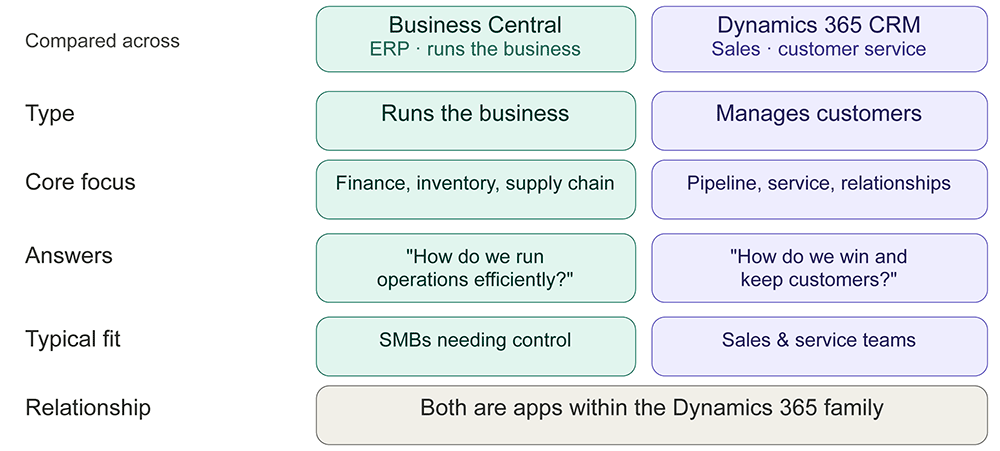
- Choose Business Central if your priority is running the business – finance, inventory, supply chain, operations.
- Choose the Dynamics 365 CRM apps (Sales, Customer Service) if your priority is managing customers – sales pipeline, service, relationships.
- Many businesses eventually use both, because they’re built to work together on the same platform.
The rest of this explains the distinction properly, so you can scope the right thing.
Why the naming is so confusing
Microsoft uses “Dynamics 365” two ways, which is the root of the whole problem.
Sometimes it means the entire family of business applications – a suite covering sales, customer service, finance, operations and more. Other times it appears in the name of a specific app within that family.
Business Central is one of those apps. So is Dynamics 365 Sales. So is Dynamics 365 Customer Service. When someone says “Dynamics 365,” they might mean the whole suite or one particular application – and that ambiguity is exactly why this comparison feels harder than it should.
Here’s the mental model that fixes it: Dynamics 365 is the family. Business Central is one member of it – the ERP one.
What each one actually does
Business Central – running the business (ERP)
Business Central is an Enterprise Resource Planning (ERP) system. Its job is the operational backbone of a business: finance and accounting, inventory, purchasing, sales orders, and supply chain.
It’s where Business Central genuinely shines – supply chain and operational visibility. Inventory levels, purchase and sales orders, production, warehouse management, all in one place, all aligned so everyone works from the same information. For a business whose pain is operational – stock, logistics, financial control, resource planning – this is the answer.
Business Central is typically aimed at small and mid-sized businesses that need a capable, all-in-one system to run operations without the weight of a larger enterprise platform.
The Dynamics 365 CRM apps – managing customers
When people compare “Dynamics 365” to Business Central, they usually mean the CRM side of the family – principally Dynamics 365 Sales and Dynamics 365 Customer Service.
These do a different job. Rather than running your operations, they manage your customer relationships: the sales pipeline, lead and opportunity tracking, customer service cases, and the interactions that turn prospects into customers and customers into repeat ones.
If your challenge is winning and keeping customers rather than running the back office, this is the side you need.
The comparison of Dynamics 365 vs Business Central at a glance
You often don’t have to choose
Here’s the part the “versus” framing hides: because Business Central and the CRM apps are all part of Dynamics 365, they’re designed to work together, not compete.
They share a common data model, so information flows between them – a sales order raised on the CRM side can connect to fulfilment and finance in Business Central without stitching two separate systems together. For a growing business, that’s often the real answer: not which one, but which first, with the other added as the need appears.
So, the practical question usually isn’t “Business Central or Dynamics 365?” It’s “where’s my most pressing pain right now – operations or customers?” Start there, knowing the other side of the platform is available when you need it.
How to decide
A simple way through it:
- Is your biggest problem operational or customer-facing? Struggling with stock, finance, orders, and planning points to Business Central. Struggling with sales visibility, pipeline, and service points to the CRM apps.
- What’s your size and complexity? Business Central suits SMBs wanting an all-in-one operational system. Larger or more complex requirements may point toward the broader enterprise applications in the family.
- What’s your growth plan? Because it’s one platform, starting with one side and adding the other later is a normal, well-trodden path – not a re-platforming exercise.
If you’re genuinely unsure, that’s usually a sign the honest answer is “it depends on specifics” – and it’s worth a proper conversation rather than a guess, because scoping around the wrong app is expensive to unwind.
Frequently asked questions
What is the difference between Dynamics 365 and Business Central?
Business Central is one application within the Dynamics 365 family – the ERP app, covering finance, inventory and operations. “Dynamics 365” can refer either to the whole family or, often, to its CRM apps (Sales, Customer Service). So the real difference is ERP (Business Central) versus CRM (the Dynamics 365 sales and service apps).
Is Business Central part of Dynamics 365?
Yes. Business Central is one of the applications that make up the Dynamics 365 family. That’s why “Dynamics 365 vs Business Central” is a slightly misleading comparison – they’re not separate, competing products.
Should I choose Dynamics 365 or Business Central?
Choose based on your most pressing need: Business Central for operational and financial management (ERP), the Dynamics 365 CRM apps for sales and customer management. Many businesses use both, since they’re built to work together.
Can Business Central and Dynamics 365 CRM work together?
Yes – they’re part of the same platform and share a common data model, so they integrate natively. Information flows between operations and customer management without bolting two separate systems together.
Which is better, Business Central or Dynamics 365?
Neither is “better” – they do different jobs. Business Central manages operations; the Dynamics 365 CRM apps manage customers. The right choice depends on which problem is more urgent for your business, and many organisations end up using both.
Still not sure which you need?
The naming makes this harder than it should be, and choosing the wrong starting point is a costly mistake to unwind. If you’d like help working out whether your priority is the ERP side, the CRM side, or both – and in what order – that’s exactly the kind of thing we help UK businesses get right before they commit.
→ Explore our Dynamics 365 solutions or book a discovery call and we’ll help you scope the right fit.


